Supplies:
- Open top carrier
- Miracle Nipples with Luer Lock 3cc, 5cc, 10cc, and 20cc syringes OR
- Pet nursing bottle with nipple that has been opened (see instructions below, how to not cut opening too big)
- Bottle brush to clean bottle (usually comes with the kit)
- Clean baby receiving blankets and other bedding such as waterproof hospital pads and disposable diapers.
- Heating pad – NOT one with automatic shut-off
- Honey or Karo syrup
- Pyrantel wormer
- Terramycin eye ointment
- Albon (for coccidia) – only by prescription
- 8 in 1 UltraCare Small Animal Flea & Tick Spray
- Lactated ringers if you’ll be doing sub-Q fluids.
- Insulin syringes if you’ll be doing sub-Q fluids.
- Just Born kitten formula, KMR kitten formula, or other appropriate kitten formula
- Small animal scale (grams/ounces), postage scale (ounces), or baby scale
- If you’re going to tube feed: a #3 ½ or #5 French feeding tube. Do NOT tube feed without training.
*Note: Whatever the internet tells you, please don’t try to feed a kitten cow’s milk. Their digestive systems do not handle the lactose and it will cause diarrhea and lack of weight gain.
Intake:
Remember, a kitten should be warm, hydrated and free of parasites before anything else happens. A cold kitten cannot process formula.
Check temperature:
Just make sure the kitten is not cold to the touch, which you can easily determine by touching the foot pads and ears. If they feel cold, the rest of him is. If so, he needs to get wrapped in a soft blanket and placed on a heating pad. Heating pads should always be set on low and there should always be a thick layer of bedding between the pad and the kitten. The bedding should feel comfortably warm to the touch – if it feels hot, you can overheat the kitten and even cause topical burns. A kitten’s body temperature should be about 99-100 degrees.
Check for hypoglycemia:
Check gums – they should be pink. If pale, it means the kitten is low in blood sugar, or cold and shocky. Wrap him in a warm baby blanket and warm him up either by holding him against your chest or by placing him (in the blanket) on a heating pad set on low.
Also apply about .5 cc honey or Karo syrup to the gums to up his blood sugar. Another possibility, if you feel comfortable injecting subcutaneous (Sub-Q) fluids is to inject lactated ringers with .5% dextrose.
Check for dehydration:
Gently pull up the skin between his shoulder blades. It is normal for kittens to have somewhat loose skin but when you pull it up (“tent it”) and release it, it should come back down immediately as opposed to remaining raised. If it comes down slowly, it means the kitten is dehydrated.
Fluids are critical for this animal. The fastest way of introducing them into his body is by injecting sub-Q fluids. Start with 1cc of lactated ringers in a tiny gauge syringe (for example, insulin syringe). Lift up the loose skin between the shoulders and inject the fluid slowly underneath the skin. Make sure that you release any air from the tip of the syringe first by holding it needle upright and plunging slowly to confirm that what is coming out is liquid.
This is not something that can wait as dehydration can kill a small animal. If you can’t do sub-Q fluids, oral syringe or bottle feed Pedialyte to the kitten before trying to feed it formula. A homemade version of an electrolyte solution is: one teaspoon salt, three teaspoons sugar mixed into one quart of warm water. Make sure the baby is warm before you give it any fluids or it won’t be able to process the fluids.
Check belly condition:
A hard, distended belly can signal constipation, worms or other issues that need to be addressed. (See below). A kitten’s belly should be soft and full, not hard or sticking out at the sides.
Check eyes:
Eyes should be clear of discharge or dry crusty matter. If the kitten’s eyes have opened, it is important that they are both clear of discharge and that one isn’t sealed shut with crust. It is very common for kittens to get this problem.
If crusty or showing discharge, kitten’s eye(s) should be gently cleaned with a very warm compress of cotton ball, tissue or cotton pad soaked and wrung out with fairly hot water. Make sure the pad doesn’t feel uncomfortable hot, but it should be warm enough to draw out infection. Do this for a couple of minutes.
After cleansing, apply ophthalmologic Terramycin ointment to the afflicted (or both) eyes. Apply a little bit to the inner corner of the eyes, and if there’s excess on the fur, gently wipe that off.
Check for fleas:
Comb through the kitten’s fur, including against the direction of the fur and especially around the lower back/base of the tail, the back of the neck, the underside of the chin and the inside of the groin and armpits.
Have on hand a piece of paper towel and a spray bottle of 8 in 1 UltraCare Flea and Tick Spray. This is designed for small animals and safe to use on kittens who are not old enough to use Revolution or Frontline. If you start to see flea dirt on the comb, spray some of the Flea and Tick Spray onto a cotton pad and gently wipe down the kitten. Then spray some more onto the paper towel and go through the whole kitten with the flea comb. As you find fleas, transfer them with the comb to the wet paper towel and squish them into the damp flea spray.
Because this is a topical solution and not systemic, you will need to continue periodically checking the kitten with a flea comb over the coming weeks as flea eggs can hatch later and create additional fleas even when you thought the kitten was clean.
Housing:
Keep kittens in a top opening carrier where you can secure the lid when you’re not taking care of them, so they can’t crawl out and get cold or hurt. Put a heating pad set on low underneath half the carrier (so that there is a section of the carrier to which kittens can crawl if they feel too warm), with a light layer of bedding between the heating pad and the carrier or even just the original cover the pad probably came with. It is vital that your heating pad does not have an auto shut-off.
In the carrier, put a small folded blanket or whatever you have that provides a soft, washable bedding base. I like to create a sort of nest that discourages kittens from crawling under the blanket and getting too hot. On top of that you can use, if you like, a disposable hospital waterproof pad or disposable diaper that can cradle the babies and provide an easy way to remove soiled bedding frequently without having to change the entire set-up. Plus there’s absorption. Personally, I change the bedding frequently and do a lot of laundry. If you go that route, acquire a large pile of baby blankets from a thrift store. For the really tiny kittens, I also tent a very light blanket on top of them for added warmth.
Feeding:
A note ahead of time: I use a notebook to note the day, time and weight of first weigh-in, time and amount of each feeding, and any comments of pee and poop. I keep this for every kitten, every day.
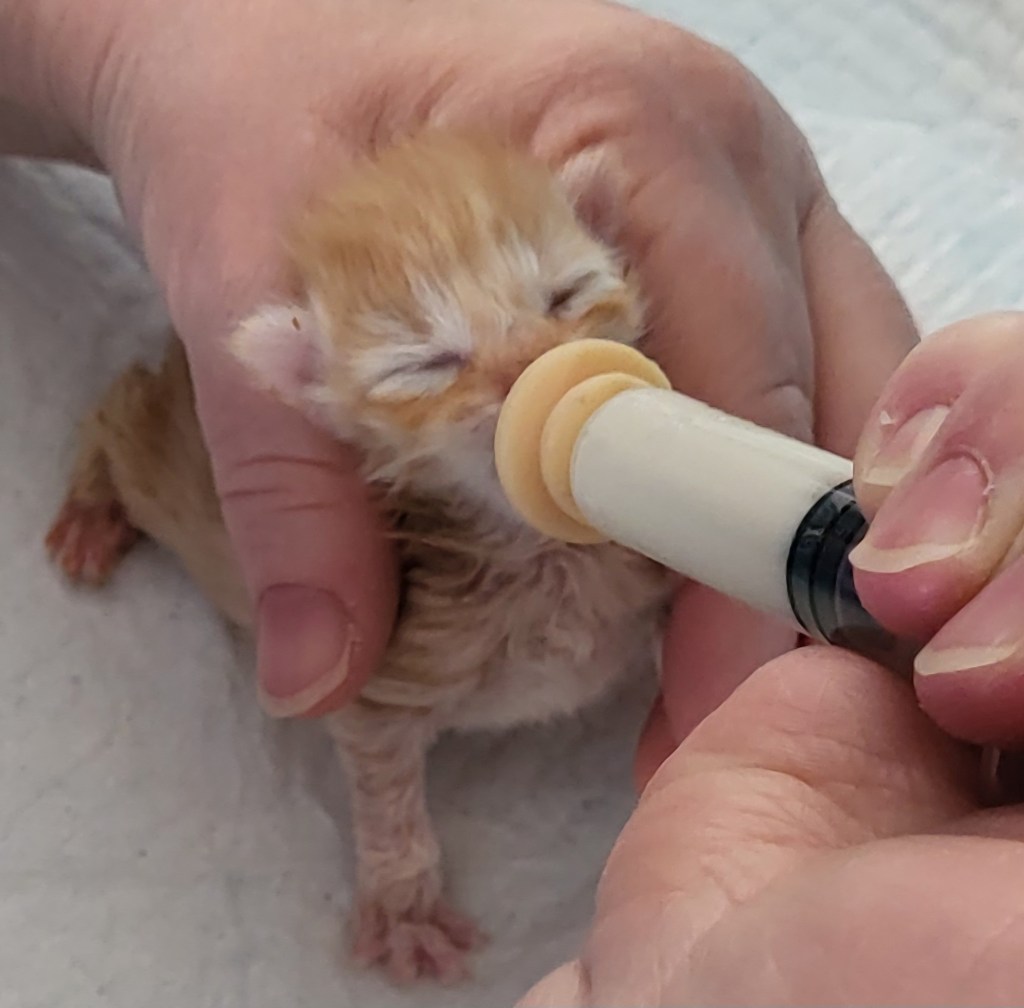
I highly recommend using a Miracle Nipple with oral syringes – if you’re planning on fostering multiple litters, the larger 10 nipple package is more economical. I like the syringe method because I can tell more exactly how many cc’s a kitten is getting per feeding, and then per day.
Alternatively, you can use a pet nurser bottle. They don’t have an opening when you unwrap a new one. You have to cut a small opening at the top with really sharp scissors. Do this carefully and start really small. If you cut too large an opening, the nipple becomes useless. You should be able to tip the bottle upside down and have the formula drip out slowly. The key word is slowly, because if it flows too quickly, very young kittens can get the formula too fast and aspirate it into their lungs. If that happens, they can develop pneumonia.
Formula should always be warm when you are feeding it to kittens. Kittens won’t (and shouldn’t) drink cold formula. You can either warm up a small amount by filling the bottle with the amount needed and immersing the bottle into a mug with very hot water until the bottle is comfortably warm, or microwaving a small amount in a separate container, stirring it thoroughly to remove hot spots and then pouring it into the bottle or drawing it up into an oral syringe. You have to be VERY careful to mix it thoroughly so there are no hot spots that can scald the kitten’s mouth. Check it on your wrist the way you would a human baby bottle’s temperature. If you’re feeding multiple kittens, transfer the formula into a small container set into a hot mug or plan to reheat after every couple of kittens. (As you feed them, the formula will start getting colder.)
The kitten should be placed belly down and head up for feeding. Never feed a kitten turned over like a human baby – it should always be upright.
The bottle should be tipped when feeding so that formula is always covering the bottom/nipple section – otherwise, you risk the kitten swallowing too much air and building up gas in its system. Additionally, it’s helpful, once the kitten has latched on to the nipple, to pull the bottle up and back just a bit to encourage the kitten to nurse with its head up and the throat unconstructed.
If the kitten gags or formula is bubbling from the nose, it’s getting the formula too fast. Tip the kitten gently nose down so that formula can run out, dab its face and nose with tissue and try again.
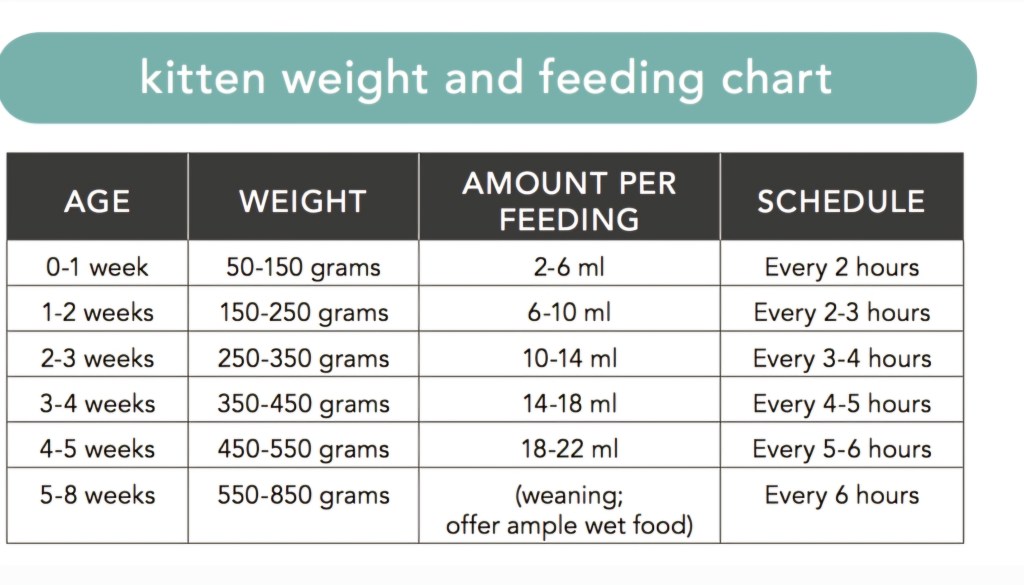
Depending upon the size and age of the kittens, they should be fed every 2-3 hours throughout the day/part of the night. The smaller they are, the more frequently they’ll need to be fed.
If they are consuming the necessary formula intake based upon body weight (see below), they should be able to get through the night with just one very late feeding and then early morning feeding, but it should not be necessary to feed them throughout the night. I feed them until it’s very late, and then allow myself about 5 hours max to sleep, and begin again very early in the morning.
*Note – if you have a dehydrated kitten coming to you late, it will need care throughout the night to continue introducing fluids into its system!
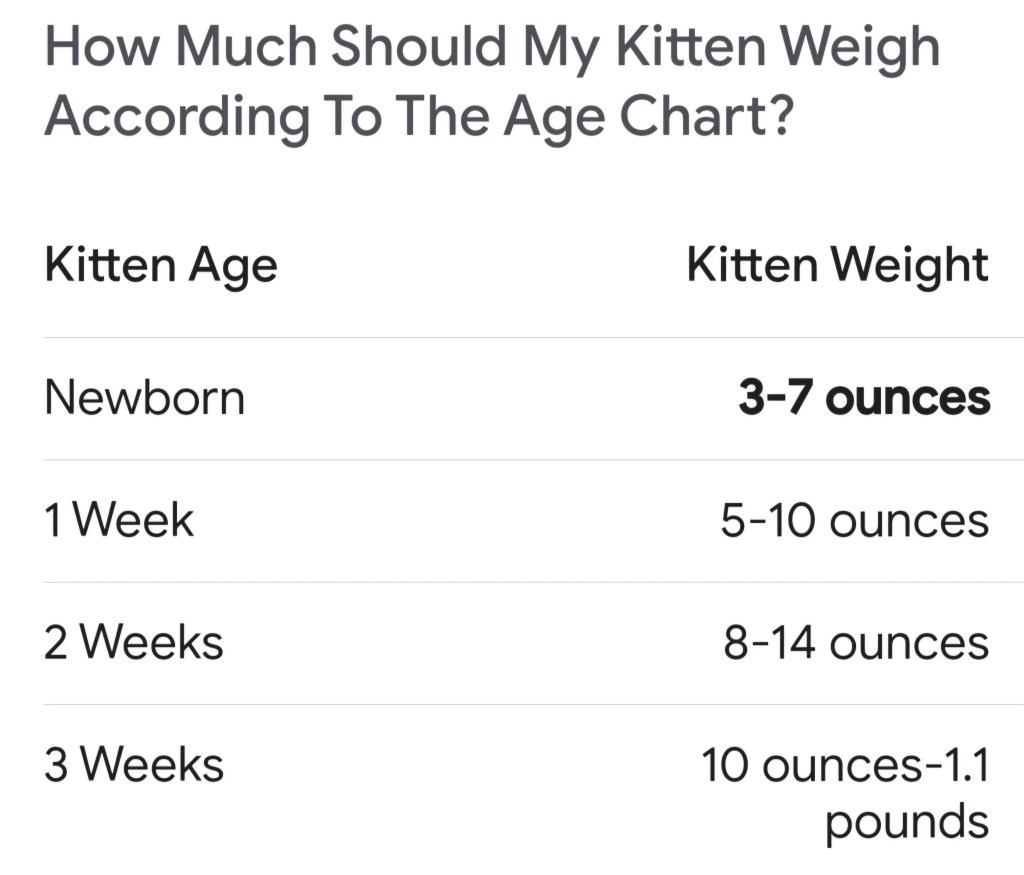
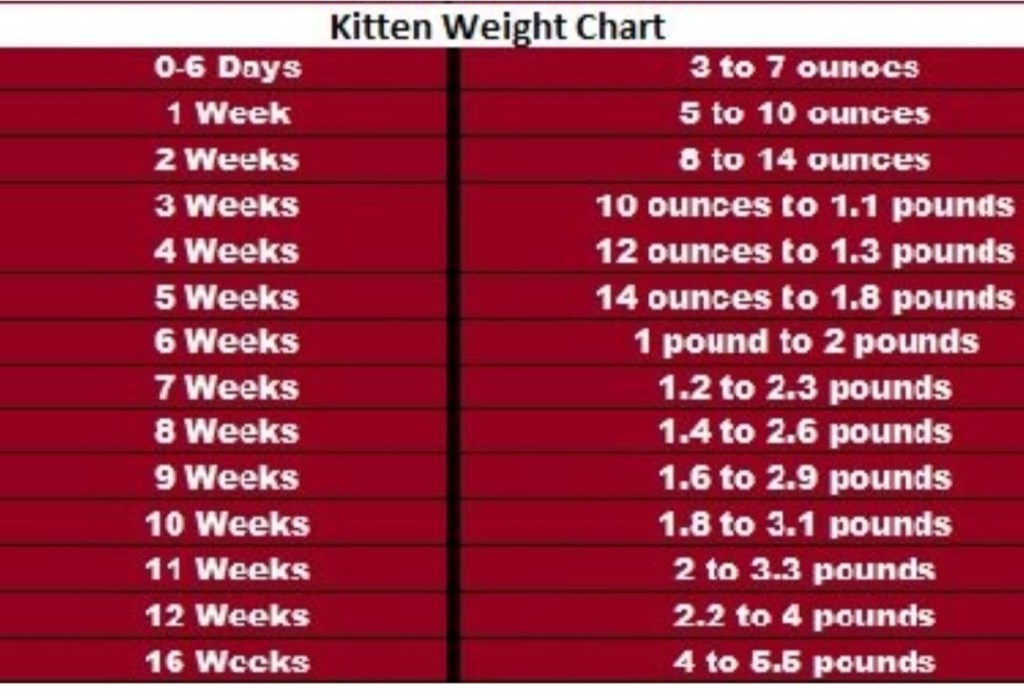
Try to weigh each kitten once a day around the same time – he should gain between 10-15 grams (half an ounce) per day. If he’s not gaining this much, he’s not getting enough to eat. Also look out for prominent backbone or hipbones – the kitten is too skinny. And look out for kittens who are trying to nurse on siblings – they also probably need additional food.
How much to feed: About 2 tablespoons of formula for every 4 ounces of body weight. So this means an infant under 1 ½ weeks old would take about 2-3 cc’s every two hours, and then after about 1 ½ weeks old would double that to about 6 cc’s every 3 hours. After 3 weeks, the kitten would eat about 12 cc’s every 4 hours but fast growing ones could take as much as 20-24 cc’s. Another weight to formula ratio used is that while they are under eight ounces in weight they should get 1 cc of formula per ounce of body weight at each feeding. That is why an accurate postage scale is a necessity. When their weight is eight ounces, give them approximately one and one half cc of formula per ounce of body weight.
If the kitten settles down after eating, it’s a good sign that he’s had enough for the time being. They’ll stop sucking when they’re full. However, if the kitten continues to mew, or he hasn’t eaten what he should, you can try topping him off with a little more formula. Sometimes they just need to burp or take a break. Burp him, feed the others and then come back around and retry. Rub the back of the kitten’s neck and upper body, between the shoulders, just like you would with a human baby, to encourage him to burp. You can also rub his belly in gentle circles.
Kitten immune systems are not fully developed so it’s really important to wash your hands before and after handling the kittens, and ALWAYS clean and sterilize your bottles, nipples, brushes, or tube feeders in very hot water after each use. If your kittens did not receive their mother’s colostrum (the watery milk the queen produces in the first couple of days after giving birth), your kittens are at an even higher risk as they did not receive the antibodies present in the colostrum.
Stimulation for Toileting:
At each feeding, aside from giving the kitten formula, it is necessary to gently stimulate it to pee and poop. This is done by wetting a cotton ball, cotton pad or facial tissue with warm water and rubbing it across the kitten’s bottom in a circular or side to side motion. This resembles the mother’s grooming and stimulates the kitten to evacuate.
Pee should be very pale yellow – darker yellow pee indicates dehydration.
Poop should be the consistency of toothpaste, light yellow and thin. Loose poop can indicate a bacterial problem if it continues – sometimes it’s a temporary problem associated with a change of formula. It may also be a temporary problem associated with overfeeding. If diarrhea continues, increase the water ratio in the formula to compensate for lost fluids. You can also replace some of the water in the mix with Pedialyte.
A loose and/or greenish color stool can indicate that bile is not being absorbed, which means the food is processing too quickly through the kitten’s system and is probably attributed to moderate overfeeding. Cut the formula back with the Pedialyte or bottled water, and check with your vet first to see if they recommend using 2 to 3 drops of Kaopectate every four hours until this problem clears up. If green stool persists, it could mean a bacterial infection, parasites, or liver problem. This is a vet’s call.
Stools that look like cottage cheese mean the formula strength is too rich, there is severe overfeeding, or the kitten may have a bacterial infection. Check with your veterinarian who may recommend that you cut the formula in half with bottled water and/or Pedialyte liquid, and start the kitten on antibiotics. If the kitten is seriously dehydrated, fluids can be given under the skin.
Hard, dark poop indicates the kitten is constipated, whether from dehydration or some other issue. Constipation can be dangerous for kittens and needs to be addressed. In this case, you would want to increase the strength of the formula, and feed slightly smaller amounts, but feed more frequently. If the kitten has a swollen abdomen and hasn’t passed a bowel movement in over a day, you may want to try mineral oil given by mouth (3 drops per ounce of body weight). Generally, the formula ratio and number of feedings will be enough to sort out the constipation.
Bedding should be changed when it gets wet, or dirty from bowel movements, etc. Wet bedding can cause urine scald. Dirty bedding encourages coccidia and other bacterial problems, resulting in sick kittens. The inside of the carrier should also be wiped down wherever there are smears. I like the Rescue wipes, which disinfect but doesn’t have fumes that can harm kittens. An easy way to keep bedding clean is to place disposable diapers under the kittens and change the diaper as needed.
Bathing:
It may be necessary to bathe the bottom area of a kitten once or twice daily if they are toileting in the carrier, if they have feces smeared on them, or if their lower bellies have become wet from urine. Not only does the bathing clean them off and avoid bacterial build-up, but the drying urine can burn their skin (“urine scald”) and cause discomfort. Usually you only have to do bottom baths. Don’t get the kitten’s head wet or allow water to run into its eyes, ears or mouth/nasal area.
Water is often sufficient but if you would like to use shampoo, use a very gentle shampoo designed for kittens, babies or sensitive skin and don’t get it anywhere near his face. I find Dawn Original dish liquid to be a great choice. The water should be comfortably warm – not too hot. Never immerse the whole kitten in water.
It’s very important not to let the kitten become chilled, so fluff it dry with a small towel and then wrap it in a dry towel and hold it or put it in a warm blanket until he has dried off. You can also use a low-noise hairdryer, set on low and held far enough away from the kitten so he doesn’t get too hot.
Additional Resources
Alley Cat Allies’ Neonatal Kitten Care – An excellent overview. The gold standard. Many thanks to Alley Cat Allies and to all the work they do.
Alley Cat Allies’ visual Kitten Aging Guide
Feeding Schedule Chart courtesy of Alley Cat Allies
Kitten Weight Chart courtesy of Alley Cat Allies
Kitten Progress Report courtesy of Alley Cat Allies
UC Davis Koret Shelter Medicine Program’s Guide to Raising Orphan Kittens includes care of the pregnant and nursing mother
Longmont Humane Society’s Bottle Baby Info and Trouble-Shooting Guide includes a great weight and cc feeding guide on page 2.
Kathleen Gallagher’s Hand Raising Orphan Kittens
Feeding-Guidelines-for-Bottle-Baby-Kittens frequency and amount chart, courtesy of Feline ORE
Momma Mia! 7 Important Tips When Caring for Momma Cats and Kittens
Suggested Guidelines When Caring for Bottle Babies
ASPCA’s Is it Male or Female Kitten? visual guide courtesy of ASPCA Pro
 Gentle Paws, for the Animal Lover